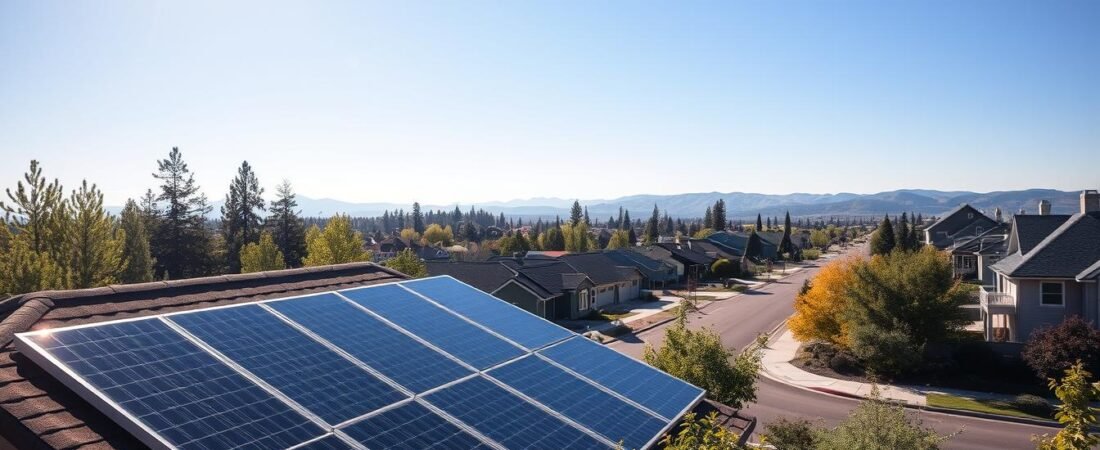
Thinking about a home energy upgrade in Bend, OR? With over 300 sunny days each year, this region is ideal for homeowners who want to lock in predictable electricity bills.
Installing a system on your roof is a serious investment, but it can pay back over the next 25 years through lower monthly charges and stable power rates.
Many residents are exploring how panels and related installation options can reduce utility bills now and protect against rising rates later. Understanding current market prices and common expenses makes planning easier.
Key takeaways: Bend sees abundant sun, installation is a long-term investment, and homeowners can expect notable savings on electricity over the years.
Understanding the Solar Landscape in Bend
In central Oregon, clear skies and long days give homeowners reliable energy production.
Local conditions matter. This city ranks among the sunniest in the Pacific Northwest, with more than 300 bright days a year. That weather supports strong year-round output from rooftop systems.
Homeowners who adopt solar panels here often report high satisfaction. They value steady generation and lower monthly utility bills.
The market is changing fast. More residents choose home solar to cut reliance on traditional utilities and lock in predictable power.
| Feature | Local Benefit | Typical Outcome | Who Sees It |
|---|---|---|---|
| High annual sunshine | More daytime output | Better year-round performance | Most homes |
| Growing installations | More installers and options | Competitive service pricing | New adopters |
| Reduced utility reliance | Lower monthly bills | Greater energy independence | Long-term owners |
Current Solar Panel Cost Bend OR Estimates
Estimating total investment starts with a clear look at the average market price per watt.
Local market data shows an average price of $2.63 per watt for a standard installation. That means a typical 12.35 kW system runs about $32,440 before incentives.
Actual totals vary with equipment choices, roof complexity, and permit fees. Use the per-watt figure to compare quotes on an even basis.
Price Per Watt Explained
The price per watt normalizes differing system sizes. It helps you see which quote offers better value for the same output.
- Average per-watt: $2.63
- Typical 12.35 kW system: $32,440 (pre-incentive)
- Many homeowners pay with cash to avoid interest; financing remains common.
| Metric | Value | Why it matters |
|---|---|---|
| Price per watt | $2.63 | Compare system proposals fairly |
| Typical system size | 12.35 kW | Matches larger family loads and maximizes local production |
| Typical pre-incentive price | $32,440 | Estimate before federal tax credit and local incentives |
| Payment choices | Cash or financing | Cash lowers long-term outlay; financing spreads upfront expense |
Takeaway: Use the per-watt figure and the sample system price to set expectations. Local incentives and the federal tax credit can lower your net price and improve long-term electricity savings from this solar investment.
How System Size Impacts Your Total Investment
How large your system is will largely determine what you pay and how much electricity you can offset.
Example: A 5 kW system in this area typically runs about $13,130. That shows how size drives the final price.
Smaller homes often choose a 5 kW setup. Larger properties may need 10 kW or more to meet higher energy usage.
Tip: Installers recommend sizing based on the past 12 months of utility data. This helps match system output to your actual home needs.
- Increasing system size raises the total cost but offsets more electricity.
- Larger systems often deliver a lower per-watt price, improving return on investment.
- Most residential systems aim to cover 100% of a home’s annual energy usage when sized correctly.
| System Size | Typical Price | Best For |
|---|---|---|
| 5 kW | $13,130 | Smaller homes, partial offset |
| 10 kW | $26,260 (average) | Larger homes, full coverage |
| 12+ kW | $32,000+ | High usage homes, EVs, pools |
Why Electricity Rates Drive Solar Adoption
Rising utility bills have pushed many local homeowners to weigh alternative ways to control household energy spending.
Rising Utility Rates in Oregon
Oregon electricity rates climbed roughly 28% between 2021 and 2024. Pacific Power reported a 2023 rate near 12.0 cents per kWh.
That steady rise has made monthly bills less predictable. More families now compare installation options to lock in long-term savings.
“Locking in your generation now can protect household budgets from future utility hikes.”
- Higher rates pushed many homeowners to seek alternatives to rising bills.
- An installation can act as a hedge against inflation and unstable utility pricing.
- With a 28% jump since 2021, choosing solar power makes financial sense for many local families.
Comparing Cash Purchases Versus Solar Leases
Choosing between owning a system outright and leasing one changes both your monthly bills and long-term gains.
Benefits of Ownership
Paying cash gives you full ownership of the system. You keep all future savings and any increase in home value.
Owners can claim tax credits and benefit from lower lifetime energy bills. You control maintenance and upgrades.
Advantages of Leasing
Leases let homeowners start saving on electricity with little or no money down. The provider handles installation and upkeep.
Leasing suits those who want lower monthly payments and fewer upfront demands. It is an easy way to reduce utility bills without buying equipment.
| Option | Upfront Money | Who Maintains | Long-term Savings |
|---|---|---|---|
| Cash Purchase | High (cash) | Owner | Maximized |
| Lease | Low to $0 | Provider | Moderate |
| Financing | Moderate | Owner (often) | Varies |
Navigating Federal and Local Solar Incentives
Claiming available tax breaks can cut your net installation bill significantly and speed up payback.
The federal tax credit allows homeowners to claim 30% of the cost of their solar system installation on their federal taxes. This federal tax credit is one of the strongest incentives to reduce upfront expense and improve long-term savings.
Many local programs add more value. Homeowners in the region often search for oregon solar rebates and other solar incentives that stack with the federal benefit.
- Reduce net expense: The 30% federal tax credit lowers your final outlay after installation.
- Layer incentives: Local rebates or utility programs often work with the federal tax credit to cut the total price further.
- Get advice: Consult your installer or a tax advisor to claim eligible credits and speed the payback.
“Applying incentives is a key step to maximize electricity savings and make a home energy upgrade more affordable.”
Understanding these programs helps you plan a smarter purchase and get the most from your investment.
Key Factors That Influence Your Installation Quote
Your installation estimate depends heavily on factors unique to your house and equipment choices.
Roof complexity is one of the biggest price drivers. Steep slopes, multiple facets, or weak decking add labor and materials.
System size and the type of modules chosen affect final numbers too. Higher-efficiency options raise the upfront price but can boost long-term energy output.
A reputable installer will inspect your roof, suggest optimal placement, and factor in local incentives when preparing a proposal.
- Compare multiple quotes to check the fair market price and detect outliers.
- Equipment quality and installer reputation can change total cost and future maintenance needs.
- Understanding size and expected power output helps match the system to your home usage.
“Getting detailed, side-by-side quotes is the best way to find true value for your installation.”
Evaluating Solar Equipment Quality and Efficiency
Equipment quality shapes long-term performance and can change how quickly your investment pays off.
Choose wisely: Monocrystalline modules are widely seen as the top residential choice in Oregon due to higher efficiency and stronger low-light output.
Why it matters: Higher-efficiency units produce more energy per square foot, which helps smaller roofs deliver more generation.
Polycrystalline options may have a lower price and still work for many homes. But they usually generate less per watt than monocrystalline systems.
Checklist before you sign: verify manufacturer warranties, confirm degradation rates, and ask your installer which option fits your roof and production goals.
- High-quality modules last 25+ years with slower efficiency loss.
- Better equipment can unlock more solar incentives and improve net returns after the federal tax credit.
- Local installers can recommend the right match for space, budget, and expected generation.
For local price benchmarks and to compare system quotes, review a trusted local guide like local panel pricing and incentives.
The Role of Net Metering in Your Savings
Net metering turns midday surplus into credits that trim your monthly bills.
When your solar panels produce more electricity than your home needs, the extra power flows back to the grid. Your utility then applies credits that offset charges when production is low.
Most homeowners in the area qualify for net metering, which helps shorten the typical payback period. The average payback period for a solar system in Oregon is about 12.6 years when net metering is included.
- Credits earned during the day reduce your evening and winter bills.
- Net metering can make a solar investment pay back faster than without credits.
- Check how your utility values excess generation to calculate true long-term savings.
“Understanding net metering rules is essential to forecast real savings and the system payback.”
| Feature | Benefit | Typical Result |
|---|---|---|
| Net metering eligibility | Credits for exported power | Lower monthly bills |
| Credit valuation | Varies by utility | Impacts payback years |
| System sizing | Maximizes credits | Improves annual savings |
How to Select a Trusted Local Installer
A trustworthy installer makes the difference between a smooth upgrade and costly headaches later.
Start by checking recent reviews and asking for references from nearby homeowners. Local firms often reply faster and stand behind their work longer than national chains.
Look for transparent financing options and clear breakdowns of price and tax incentives. A good company will explain how the system size affects savings and how to claim any available credit.
Ask about workmanship warranties, permits, and who handles post-installation support. Request detailed quotes so you can compare true value, not just the upfront price.
- Verify past projects in Oregon and request photos or contacts.
- Confirm the installer helps file for solar incentives and tax credits.
- Choose a partner that offers fair maintenance plans and honest financing options.
“Selecting a local, reputable installer protects your money and maximizes long-term savings.”
For vetted services and local expertise, check this trusted provider’s offerings: local installation services.
Long Term Financial Benefits of Going Solar
A home energy upgrade can act like a long-term savings account that grows as utility rates rise.
Real savings: Homeowners in Bend, OR can expect average savings of about $47,679 over 25 years by installing a system. That figure shows how a smart purchase can pay off.
The typical payback period runs near 12 years, after which the system delivers largely free electricity for decades.
Key advantages include protection from rising rates, reduced monthly bills, and increased home equity whether you use cash or financing.
- Use the federal tax credit and local incentives to lower upfront costs.
- Choosing the right system size improves long-term returns and cuts ongoing power expenses.
- Generating your own power reduces reliance on the utility and stabilizes household money planning.
“A well-sized installation can convert an upfront spend into decades of predictable savings.”
For details on incentives and local guidance, see this local guide to incentives.
Conclusion
, Choosing a home energy upgrade today can secure steady savings and reduce your dependence on grid prices.
Use the 30% federal tax credit and local incentives to shrink your upfront bill and speed payback. Compare quotes from trusted local installers to find the best quality and price for your project.
With more than 300 sunny days per year, your house is well suited to generate reliable power for many years. A well-sized system often produces sizable returns while cutting monthly utility charges.
Start by calculating expected savings and exploring financing that fits your budget. Small steps now can lead to large gains later for your home and wallet.