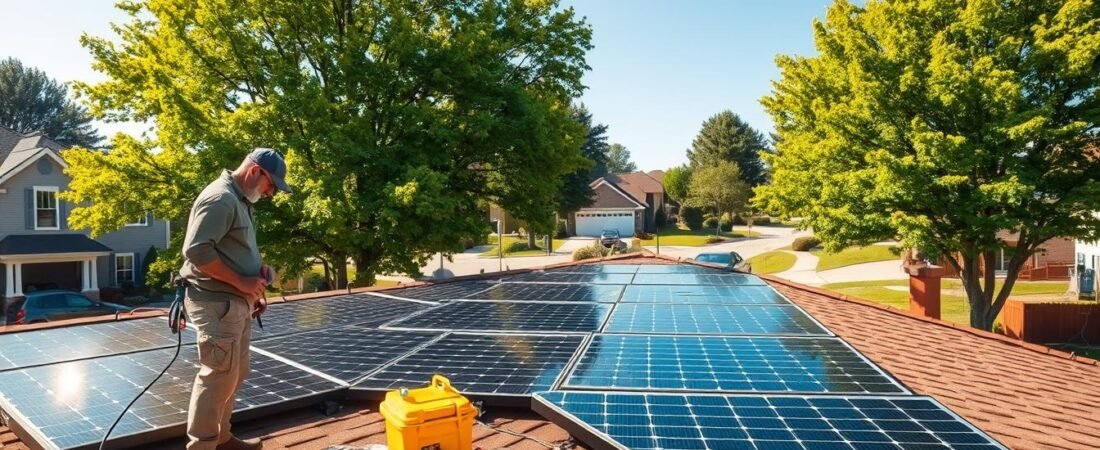
Thinking about a home system? This guide breaks down what homeowners should expect for price and return on investment. As of April 2026, the market average is $2.59 per watt, which translates to roughly $36,587 for a 14.11 kW system before incentives.
Over 25 years, households in the state typically save about $72,805 on electricity. The average payback time is near 9.76 years, and systems are built to provide clean energy for 25–30 years.
Final prices vary with roof orientation, local utility rates, and the size of the array. Net metering and available incentives can improve returns. By comparing quotes from several companies, you can protect your cash outlay and maximize long‑term energy savings.
Understanding Solar Panel Installation Cost Maryland
Understanding what drives the price of home systems helps homeowners make smarter choices.
The average price in the state sits near $3.01 per watt before the 30% federal tax credit. Nationally, residential systems average about $3.03 per watt. Larger systems usually lower the per-watt price because suppliers offer bulk discounts.
High-usage households need bigger systems. That raises the total price but also boosts lifetime savings on electricity. Choosing the best companies matters. A reputable installer will support the system for the next 25 years.
Net metering remains a key factor for offsetting monthly bills. Be cautious of quotes that seem unusually low; they can signal poor equipment or risky business models.
- Average local price: $3.01/W before incentives.
- Bulk purchases reduce per-watt rates for larger arrays.
- Net metering improves short-term payback and long-term value.
| Metric | Maryland Avg | U.S. Avg |
|---|---|---|
| Price per watt | $3.01 | $3.03 |
| Typical system life (years) | 25–30 | 25–30 |
| Federal tax credit | 30% | 30% |
Average Pricing for Residential Solar Systems
Start with size when you plan a home system. The number of kilowatts you choose directly sets the total price and the number of modules needed. Use size as your baseline before you compare quotes.
System Size Impact
A 5 kW system in the state runs about $12,966, while doubling to 10 kW is roughly $25,932. The average system size sits at 14.11 kilowatts, making it a key benchmark for many homeowners.
A common 7.2 kW setup offers a practical midpoint for estimating post‑incentive savings and payback time. Larger systems need more panels and raise upfront cash needs, but they also increase long‑term electricity savings.
Price Per Watt
Price per watt is the clearest way to compare offers from different installers. It normalizes totals so you can spot fair deals.
- Use per‑watt pricing to compare companies and equipment fairly.
- EnergySage Marketplace data shows comparing quotes can cut prices by up to 20% versus working with a single company.
- Factor in net metering and incentives when you calculate final savings over the years.
Key Factors Influencing Your Total Investment
A handful of on-site details can swing your project price by thousands. Understanding these variables helps you get a realistic quote and plan your long-term solar investment.
Roof Characteristics
Roof type and layout matter. Shingle, standing-seam, and ribbed roofs use different mounts and labor. Roof-mounted systems are usually cheaper than ground mounts or carports.
Energy Consumption
Higher household electricity use requires a larger system. A bigger size raises upfront prices but boosts lifetime savings and energy independence.
Shading and Weather
Shade from trees or buildings lowers production. You may need extra panels to offset losses, which increases installation costs.
- Distance to the utility meter affects wiring and labor.
- Local weather changes efficiency but Maryland’s climate is generally favorable.
- Installers will evaluate roof and usage to estimate final installation costs.
| Factor | Effect | Outcome |
|---|---|---|
| Roof type | Mounting method | Alters labor & prices |
| Shade | Reduced output | May need more panels |
| Distance to meter | More wiring | Higher material/labor |
Navigating Federal and State Solar Incentives
Tax credits and state programs turn a large upfront purchase into a smart long‑term investment.
The federal investment tax credit currently covers 30% of the installed system value. That credit directly reduces the federal tax you owe, lowering your net price in year one.
At the state level, homeowners can sell Solar Renewable Energy Credits (SRECs) for extra money based on generation. Maryland also waives property tax increases tied to systems and exempts them from sales tax, protecting yearly bills.
The Maryland Solar Access Program grants $750 per kW to eligible low‑to‑moderate income households. Learn more about eligibility and claims through the program page: Solar Access Program grants.
- Federal tax credit: claim 30% of total combined expenses as a credit.
- SREC market: sell credits for each 1,000 kWh generated to earn recurring revenue.
- Net metering: use the grid as free storage and receive retail‑rate compensation for excess energy.
Many local companies can guide homeowners through forms and filings so you capture every available incentive. Combining federal and state credits can drastically lower your net cost and shorten payback periods.
Financing Options for Your Home Energy Upgrade
Your financing choice can decide whether you see savings in month one or years down the road.
Loans let homeowners own the system while spreading payments over time. Many lenders offer $0‑down options so you can lower your electricity bill from day one.
Leases and PPAs require no money up front. They provide immediate monthly savings because you pay a set rate for power rather than buying equipment.
Weighing ownership against leasing
Owning maximizes lifetime savings but may raise your short‑term outlay if you pay cash. Financing reduces that hit but adds interest, which raises the total cost over time.
Leasing transfers most maintenance and the tax credit handling to the provider. Some companies pass tax credit value to customers through lower rates. That can make a lease attractive to cash‑constrained homeowners.
- Compare total payments: loan interest versus cash.
- Check whether the leasing company applies the tax credit to your rate.
- Speak with reputable companies to match financing to your money and power goals.
Comparing Equipment Types and Installation Methods
Choosing the right equipment and mounting style has a big effect on performance and long-term value.
Monocrystalline modules are the most efficient choice for most homes. They produce more power per square foot and usually need fewer units for the same output.
Polycrystalline options are rarely used today for residential setups. They cost less up front but deliver lower efficiency and larger array size to meet demand.
Roof mounting varies by roof type. Shingle roofs use flashing to seal attachments, while standing‑seam metal roofs rely on clamps to secure mounts without drilling.
Flat roofs often employ ballast mounts. These use weighted blocks to hold panels in place and avoid roof penetrations.
Ground‑mounted systems and carports need more framing, trenching, and labor. That makes them pricier than most roof options, though they can offer ideal tilt and space for larger systems.
- Module type affects efficiency and final price.
- Mounts differ by roof: flashing for shingles, clamps for standing‑seam, ballast for flat roofs.
- Ground mounts and carports increase material and labor needs.
- Inverter selection is a key factor for performance and long‑term energy yield.
Long-Term Maintenance and System Reliability
Keeping your system productive over decades hinges on simple, regular care. Modern arrays need little hands‑on upkeep because they have no moving parts and rain does most of the cleaning.
Cleaning and Snow Removal
Routine cleaning is rarely required. Most debris washes away with weather, and minor dust does not significantly harm energy output.
Snow usually sheds naturally as panels warm in sunlight. Avoid climbing onto the roof to clear snow; call a pro if buildup becomes a safety concern.
Warranty Coverage
Manufacturer guarantees typically run 25–30 years for modules and 12–25 years for inverters. Some providers add service promises — for example, Paradise Energy’s Triple Ten Guarantee includes monitoring and production assurances for ten years.
- Minimal maintenance keeps utility bills steady and long‑term reliability high.
- Use certified technicians for wiring or equipment faults to protect warranties.
- Regular monitoring flags drops in production so you can act before costs rise.
Evaluating the Return on Investment
Calculating long-term returns lets homeowners see if a home upgrade is a smart use of money.
Most homeowners in the state see a payback between 8.4 and 9.76 years. After that point, monthly bills fall sharply and savings add up.
- 25-year savings: a typical system can avoid over $69,000 in electricity costs.
- Tax help: the 30% federal tax credit lowers the net cost and shortens payback.
- Net metering: credits for excess energy boost year-to-year savings.
- Property value: arrays increase home resale value as a tangible asset.
- Predictable returns: energy savings are often steadier than many market investments.
- Calculate your ROI: factor system size, local rates, and net cost after credits.
| Metric | Typical Value | Why it matters |
|---|---|---|
| Payback period | 8.4–9.76 years | Determines when net savings begin |
| 25‑year avoided bills | $69,000+ | Shows long-term money saved |
| Net cost after tax credit | ~70% of upfront price | Reduces payback and improves ROI |
Selecting the Right Solar Installer
Choosing a trusted company reduces surprises and helps you capture available credits and incentives.
Start with reputation. Look for firms like Nova Solar, Palmetto, IntegrateSun, Lumina Solar, and Ipsun Solar that are known in the region for clear contracts and solid warranties.
Compare multiple quotes to spot fair prices and equipment quality. Use the EnergySage marketplace to get side‑by‑side offers from vetted local teams.
Smaller, family‑owned companies often deliver more attentive service over the 25‑year life of your panels. A good installer will also walk you through the federal tax credit and local incentives to maximize your savings.
- Verify licenses, reviews, and completed project photos.
- Confirm workmanship and manufacturer warranties in writing.
- Ask how companies handle monitoring and post‑service support.
| Factor | Why it matters | What to check |
|---|---|---|
| Reputation | Predicts service quality | Reviews, refs, project photos |
| Warranties | Protects long‑term output | Written product & labor terms |
| Price transparency | Avoids hidden fees | Detailed quotes and scopes |
Conclusion
A thoughtful upgrade delivers predictable savings and stronger resale appeal for years to come.
By claiming the federal tax credit and local incentives, you can shrink net costs and speed payback. Choosing the best solar companies and qualified installers helps protect performance and warranty coverage.
Investing in reliable solar panels maryland homeowners trust is a smart long‑term investment that cuts bills and adds value. Request multiple quotes so you can compare equipment, warranties, and true out‑the‑door costs.
Take action now to lock current pricing and begin earning savings and peace of mind for many years.