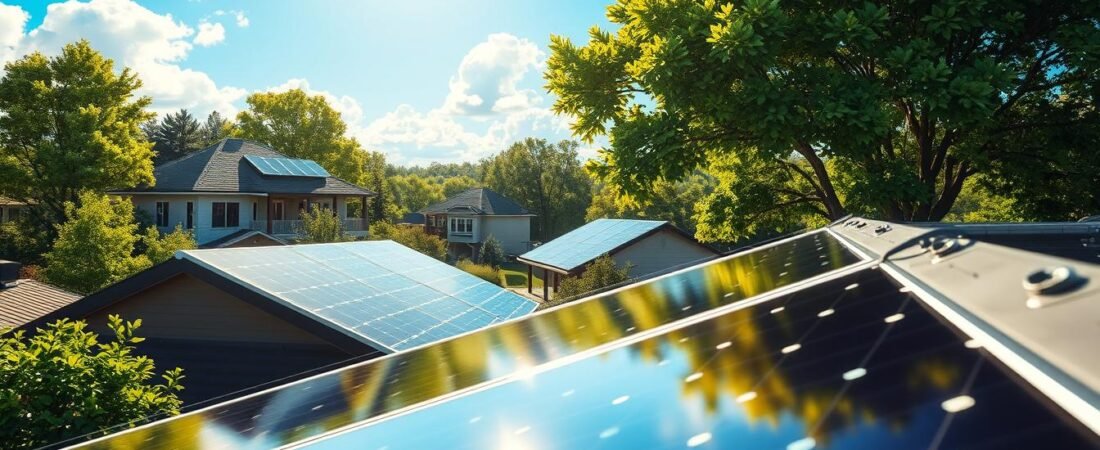
Thinking about a rooftop system? This quick guide lays out the local numbers and next steps for homeowners in north carolina. As of April 2026 the average system runs about $2.23/W including installation, a clear baseline for budgeting. You can use a simple calculator to get a tailored estimate based on your roof and usage.
With roughly 5.1 peak sun hours daily and over 213 sunny days a year, homeowners here can maximize output. An average-sized installation can lead to about $31,790 in utility savings over 25 years after the upfront expense.
Compare custom quotes through the EnergySage Marketplace to find the best value for your home. Exploring financing, available rebates, and system options early helps lock in predictable bills and makes the investment easier to plan.
Understanding the Solar Panel Cost Raleigh Market
Region-specific rates, installer bids, and incentives determine what a typical homeowner will pay today.
The local benchmark is $2.23/W as of April 2026. That figure helps when you compare quotes from competing installers. It covers equipment, labor, permits, and basic installation fees.
North Carolina saw a 24% rise in electricity prices from 2020–2024. That shift pushed many households to evaluate rooftop generation for stable long-term bills.
| Metric | Typical Value | Why it matters |
|---|---|---|
| Price per watt | $2.23/W | Benchmark for comparing offers |
| 13.33 kW system | $29,661 | Market average before incentives |
| Utility trend | +24% (2020–2024) | Drives interest and ROI |
When evaluating a quote, check how federal tax credits and local incentives change the final price. Duke Energy Progress rates and local program rules will also affect your payback timeline.
Factors Influencing Your Total System Price
Sun angle, shading, and household demand combine to shape the true price tag for a residential system. These variables decide how many modules you need and how much power they will actually produce. That, in turn, affects final prices and payback time.
Roof Angle and Orientation
The angle at which sunlight hits your roof affects output the most. South-facing roofs in north carolina typically yield the highest production.
Shading from trees or nearby buildings can cut generation and lower returns. Installers check tilt and azimuth before quoting a price per watt.
Energy Usage Patterns
Your daily electricity habits determine ideal system size. High daytime use may let you install a smaller setup and get quicker savings.
Remember: larger systems cost more upfront. Comparing offers by $/W helps you evaluate installation quotes and potential tax and incentive eligibility.
Average Costs Based on System Size
Estimating expenses gets simpler once you pick a target system size for your home. Small systems suit low-usage homes, while larger setups scale predictably.
Typical price points: a 3 kW setup runs about $6,781. A 5 kW system is near $11,302, and a 10 kW system roughly $22,603.
The state average system size is 13.85 kW, with an average pre-incentive price of $31,301. Doubling size usually doubles the price, so scaling is predictable when planning a panel installation.
Use a reliable calculator to get an estimate tailored to your roof, usage, and local north carolina pricing. That helps you confirm the right system size to offset annual electricity needs.
- Match size to usage to avoid overspending on unused capacity.
- Check quotes for the same size so price per watt compares fairly.
- Proper sizing improves long-term energy returns and payback.
Financial Benefits and Long-Term Savings
A home energy system can pay for itself over time through steady utility savings. In north carolina, homeowners typically see meaningful reductions on monthly bills once a system is online.
What owners can expect: the average homeowner saves about $34,368 in electricity over 25 years. With rates up roughly 25% since 2021, that future savings looks larger each year.
Most systems last 25–30 years. After the average payback period of about 13.96 years, year-by-year generation becomes pure savings compared with buying power from the grid.
Calculating Your Payback Period
To estimate payback, divide your upfront cost by expected annual savings. Include local incentives and federal tax credits to shorten that timeframe.
| Metric | Typical Value | Why it matters |
|---|---|---|
| 25-year savings | $34,368 | Long-term money kept versus utility bills |
| Average payback | 13.96 years | When savings offset upfront cost |
| Expected lifespan | 25–30 years | Years of predictable energy and returns |
| Rate increase since 2021 | ≈25% | Boosts value of generating your own power |
Taking available incentives and tax credits into account can reduce your payback time. That makes the investment stronger for most homes in north carolina.
Navigating Local Incentives and Rebates
Local rebates and utility programs can shave thousands off an installation when you pick the right combination. Understanding available incentives in north carolina helps you compare net prices and choose the best path when going solar.
Duke Energy PowerPair Program
The PowerPair program offers a one-time rebate of up to $9,000 for approved solar-plus-battery systems installed by authorized contractors. That rebate can cut upfront costs and improve payback for homeowners who add storage.
Virtual Power Plant Credits
Duke Energy’s EnergyWise Home program lets battery owners earn up to $92/month in bill credits by joining a virtual power plant. These monthly credits stack with rebates and reduce yearly electricity bills.
Net Metering Bridge Policy
Under the Net Metering Bridge (NMB) policy, customers receive credits of $0.034/kWh for excess electricity exported to the grid. Combine this with federal tax options and programs like EnergizeNC to lower long-term costs.
- Federal tax benefits can be passed through via leases or PPAs in some agreements.
- EnergizeNC targets low-to-moderate income households with grants to expand access to battery storage and systems.
- These incentives and rebates are essential to maximize long-term savings and reduce the final price of your panels and system.
Exploring Financing and Leasing Options
How you fund a home energy system can change both short-term budgets and long-term savings.
Leases and PPAs let homeowners in north carolina go live with no upfront cost and little maintenance responsibility. The provider owns and maintains the panels, and you pay a fixed monthly fee or per-kWh rate.
Loans let you own the equipment. That ownership can boost long-term savings but may reduce near-term cash flow because interest affects the total investment.
- Palmetto’s LightReach lease offers a fixed payment from about $95/month for medium-sized homes.
- Leasing removes maintenance risk; financing can capture tax credits and increase resale value.
- Compare terms: monthly payment, escalation clauses, and who keeps credits at contract end.
| Option | Upfront | Ownership | Typical Benefit |
|---|---|---|---|
| Lease / PPA | None | Provider | Low entry; no maintenance |
| Loan | Low to moderate | Homeowner | Long-term savings; tax credits |
| Cash | High | Homeowner | Maximum lifetime savings |
Tip: weigh monthly payments against projected electricity savings to decide which option fits your home and budget.
Comparing Top Solar Installers in the Triangle
Finding a trusted contractor in the Triangle helps avoid surprises during installation and beyond.
8MSolar (Cary) offers a lifetime workmanship and roof penetration warranty. That warranty gives homeowners long-term protection.
Emerald Energy LLC has been a top EnergySage contractor in north carolina for 16 years. Their local experience shows in smooth permitting and installs.
Yes Solar Solutions is the only NABCEP-accredited company in the Carolinas. Accreditation signals rigorous training and consistent quality for every system.
Palmetto Energy completed over 2,000 installations across the state since 2020. Their volume demonstrates field experience and repeatable processes.
Tip: compare multiple quotes from these vetted companies to find the best price and service for your home this year.
| Company | Key Strength | Local Experience |
|---|---|---|
| 8MSolar | Lifetime workmanship & roof warranty | Cary-based, Triangle focus |
| Emerald Energy LLC | Top EnergySage contractor | 16 years in NC |
| Yes Solar Solutions | NABCEP accreditation | Carolinas-only distinction |
| Palmetto Energy | High installation volume | 2,000+ installs since 2020 |
Evaluating Your Home for Solar Potential
A quick roof and usage check reveals whether your home is a strong candidate for a system.
Start with peak sun: Raleigh averages 5.1 peak sun hours per day. That number helps predict how many panels you need and what system size will meet your electricity goals.
“Homes with solar panels sell for about 4.1% more than similar homes,” says a Zillow analysis.
Next, inspect roof orientation and shading. South-facing roofs with minimal shade deliver higher yearly energy. Steep shade or odd roof angles can reduce output and affect installation choices.
Review past energy bills to fine-tune the system size. Matching generation to usage avoids oversizing and improves return on your investment.
- Check sun hours and roof exposure.
- Compare bills to size the system correctly.
- Get a pro audit for an accurate site assessment.
Use a solar calculator to estimate production and savings before signing a contract. A professional installer will confirm feasibility and expected performance for north carolina homes.
Strategies for Reducing Your Installation Costs
Careful comparison of installers and incentives often delivers the biggest savings on a home system.
Start by collecting at least three quotes. Competing bids commonly bring prices down by as much as 20% versus a single offer. Ask each provider for a line-item estimate so you can compare equipment, labor, and permit fees.
The Importance of Comparing Multiple Quotes
Being an educated shopper pays off. Research local rebates and utility programs in north carolina before signing. Some lease options let you access the federal tax credit indirectly, which lowers the effective upfront cost.
Monitor utility rates and state incentives over time. Small timing shifts—waiting for new rebates or seasonal installer promotions—can shave hundreds or thousands from the final price.
- Get custom estimates from several providers to match roof and energy needs.
- Compare financing, warranties, and who claims tax benefits.
- Stack rebates and tax credits whenever allowed to reduce upfront payments.
| Strategy | Typical Impact | Why it helps |
|---|---|---|
| Multiple quotes | Up to 20% lower price | Creates competition and transparency |
| Leases with credit access | Lower effective upfront cost | Pass-through of federal tax benefits |
| Local rebates timing | $500–$9,000 | Direct reduction to installation price |
| Shop financing | Lower monthly payments | Matches savings to budget and rates |
“Comparing bids and incentives is the single most effective way to cut installation costs.”
Conclusion
A clear plan—size, financing, and installer—makes the path to clean power simple and actionable.
Investing in a solar panel system is a strong way to lock in energy bills for your home in north carolina. Compare multiple quotes to control the overall cost and confirm the right system size.
Whether you pick cash or explore financing options, there is a route that fits your budget. Proper planning shows how much solar can boost long-term savings and increase property value.
Start with a site assessment and a few vetted bids. That single step moves you closer to energy independence and reliable, lower bills for your home.