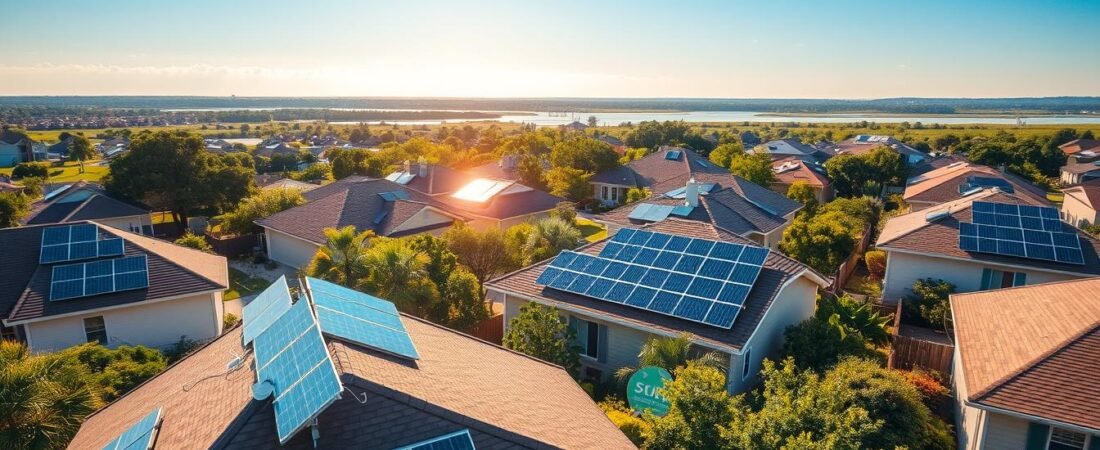
What do most homeowners ask first? They want a clear number they can compare to a quote. In Baton Rouge today the average system clocks in at about $2.64/W with a typical size near 10.88 kW.
That adds up to roughly $28,677 before incentives, with normal estimates running from about $24,375 to $32,979. These figures give you a quick benchmark to judge if a proposal is fair.
This guide breaks down price by system size, compares local pricing to Louisiana averages, and shows how to read installer proposals in plain terms. You’ll also learn which incentives can shift the net figure and how to confirm what applies to your home and financing choice.
Expect practical shopping steps: get multiple quotes, check warranties, and watch for common red flags so you avoid overpaying and hire a reliable installer.
What solar costs look like in Baton Rouge right now
To size up a quote quickly, start with the installed price per watt for your area. That metric shows the price you pay for each watt of installed capacity and makes quotes comparable across installers.
Average installed price per watt (Feb 2026)
The current benchmark in Baton Rouge is $2.64/W. Use that number as the present-market reference, not older averages that no longer reflect local pricing.
Typical total for a 10.88 kW system
Multiply the per-watt figure by system size: 10,880 watts × $2.64/W ≈ $28,677 before incentives. That gives a concrete total you can budget against.
Good vs average vs high price bands
- Good price: $24,375 or less — strong value if equipment and warranties check out.
- Market average: $28,677 — a fair, typical offer.
- High price: $32,979 or more — ask questions before accepting.
Remember: system size and pricing shape your payback and how much your monthly electric bills fall. Treat these numbers as benchmarks: roof condition, equipment choices, and installer labor will change final totals. For a local pricing snapshot, see current installer data.
solar panel cost baton rouge by system size
Use this size-to-price snapshot to see how smaller starter systems compare with mid-size setups.
Estimated installed costs for smaller homes and starter systems (3–6 kW)
Smaller homes or those aiming for a partial offset often pick 3–6 kW systems. Typical installed totals (pre-incentives) run: 3 kW $7,911, 4 kW $10,548, 5 kW $13,185, 6 kW $15,822.
Mid-size system pricing snapshots (7–10 kW)
Families with higher usage usually choose mid-size systems. Recent local examples show 7 kW $18,459, 8 kW $21,096, 9 kW $23,733, and 10 kW $26,370.
How to compare installers using $/W
The easiest apples-to-apples metric is price per watt. Divide the total by system watts to compare proposals even when sizes differ.
Make sure each quote includes labor, permitting, interconnection, racking, standard inverters, and basic warranties. A low bid that skips these items can raise bills later.
Tip: Get at least two proposals and use the size-to-price ladder and $/W math to negotiate or walk away if a company’s prices look inflated. For a local pricing snapshot, see local pricing snapshot.
Baton Rouge vs Louisiana averages: how local pricing compares
A close look at per-watt figures and system sizes shows small gaps that can change totals meaningfully.
Statewide benchmark: Louisiana (Feb 2026) averages about $2.67/W with a typical system size near 11.65 kW. That converts to roughly $31,082 before incentives, with a common range of $26,420–$35,744.
Local snapshot: baton rouge (Feb 2026) sits at $2.64/W and an average system size of 10.88 kW, or about $28,677 before incentives. The local range runs roughly $24,375–$32,979.
The per watt gap is small — $0.03/W — but on an 11 kW installation it equals several hundred dollars. Local competition, permitting speed, and installer practices often explain that difference.
Use both comparisons: if a quote is above both the baton rouge and Louisiana averages, ask for itemized line items and get more bids. Benchmarks don’t replace a site assessment, but they stop you from shopping blind.
What drives the cost of solar panels and installation in Baton Rouge
Local site needs and equipment choices explain most price differences. Your energy use and roof tell an installer how big a system you need. That size is the single largest driver of total price because you buy power production, not just panels.
System size and household energy
Estimate yearly kWh to pick a system size. Bigger homes or EV owners need more capacity, which raises the price but increases covered energy.
Equipment choices that move the price
Higher-efficiency modules and premium brands cost more but save space on small roofs. Inverters matter: string inverters are cheaper; microinverters or optimizers help shaded roofs and can boost long-term power and maintenance simplicity.
Roof, site, and electrical realities
Tall trees, complex roof pitches, or an aging roof add labor and materials. If your breaker panel needs upgrading, expect extra fees and permitting work.
Installer pricing and buyer mindset
Quotes vary by labor rates, permitting experience, warranties, and project management. Aim for value over the cheapest bid: strong warranties and clear scope protect your investment.
Incentives, credits, and buyback programs that change your net cost
Incentives and buyback rules can turn a headline price into very different out-of-pocket totals. Two neighbors can accept identical quotes yet pay very different amounts after incentives, taxes, and utility buyback are applied.
Federal tax realities (2026): ownership type matters. According to current guidance, the federal tax credit is not available for systems bought with cash or a loan in some cases, but providers offering leases or PPAs may pass value to customers indirectly.
Local and state incentives: Louisiana and municipal programs may still offer rebates, property-tax exclusions, or utility credits. Always check current offers — even small rebates reduce net money spent and shorten payback.
Net metering vs net billing
Net metering credits exported electricity at retail rates, which raises long-term savings. Net billing or lower buyback rates cut those savings and lengthen payback.
- Ask installers: which incentives did you include?
- Who files paperwork and claims credits?
- What buyback rate did you assume, and what if policy changes?
Verify everything before signing. Policies shift, and knowing who claims each credit keeps surprises off your final bill.
Is going solar worth it in Baton Rouge? Payback period and long-term savings
Deciding if going green pays off here means focusing on how long until savings outweigh the upfront investment.
Typical local payback period: quote-based estimates put the average payback period for Baton Rouge at about 17.05 years (EnergySage). Other published models, like EcoWatch, show a shorter period (~14.9 years) because assumptions differ on electricity rates, degradation, and buyback.
What speeds that period up
Faster payback comes from a low $/W price, strong sun exposure, favorable net metering or buyback, accurately sized systems, and rising utility rates. Each factor trims the years until break-even.
25-year savings and warranties
EnergySage projects about $15,605 in 25-year savings for local installs; EcoWatch gives higher figures under different assumptions. Remember warranties often cover ~25 years of performance, so production estimates matter as much as the purchase price.
ROI over time
Early years usually show negative cash flow as you repay the initial investment. Year-by-year ROI often turns positive in the later years of a 20–25 year span. Use payback and ROI as planning tools and demand clear, transparent assumptions on production and electricity pricing from any installer.
How to estimate your home’s solar panel system size and price
Start by converting a year of electricity use into a practical kW target for your home. Gather twelve months of bills and add the kWh totals to get annual energy use. Divide that number by 1,500–1,700 (local production per kW in this region) to get a rough system size.
Full offset vs partial offset: A full-offset system aims to match your annual energy. A partial system reduces monthly bills but costs less up front. Both are valid choices depending on budget, goals, and available roof space.
Production factors that change how much a system makes
Sun exposure, shading, roof orientation, and seasonal weather affect yearly output. South-facing roofs with low shade produce more. Complex roofs or tree shade lower production and raise the required size.
Use the 10.88 kW benchmark as a local reference point, not a rule. If you plan to add an EV or grow energy use, size up. Installers should give an annual kWh production estimate and a total price so you can compare cost-per-output.
Quick checklist before requesting quotes
- Recent 12 months of electricity bills (kWh totals).
- Roof age, material, and condition notes.
- Photos or notes about shading and orientation.
- Planned changes (EV, new appliances, or additions).
Bring this data to installers so quotes match your needs. Clear inputs lead to accurate production estimates and fair pricing.
Ways to pay: cash, solar loan, lease, or PPA
How you pay affects savings more than many homeowners expect. Pick a route that matches your budget, risk tolerance, and whether you want ownership over time.
Buying with cash
Cash gives the highest lifetime savings. No interest and full ownership mean you capture all performance gains and any future sell or rebate value.
Loans and $0‑down options
Loans let you spread the price. A $0‑down loan can provide saving on day one if monthly payments beat your electric bill.
Remember: interest and fees reduce long-term savings. Compare APR, term, and prepayment rules before you sign.
Leases and PPAs
Leases and PPAs lower upfront money and often act like a pay-for-power plan. The provider usually owns the system and may keep the tax credit or reflect it in pricing.
“Lower up-front money can mean smaller monthly bills, but less long-term value.”
How financing affects total costs over years
- Interest, term length, and fees drive total costs.
- Ask who claims any tax credit or credit value.
- Decide by asking: How long will you stay? Do you want ownership? Do you prefer max savings or low upfront cash?
How to shop smart and lower your solar panel installation costs
Bringing several companies into the process creates competition that often trims installation prices without cutting quality. Get three solid bids to compare scope, equipment, and warranties.
Why multiple quotes matter
Pricing for installation varies widely by company because labor, experience, and local practices differ. EnergySage data shows marketplace shoppers may see prices up to 20% lower than working with a single installer.
What to review in proposals
- Equipment model numbers and inverter type (string vs micro).
- Monitoring and expected annual production with assumptions.
- Workmanship warranty length and panel performance warranty.
- All line items: permitting, interconnection, and any electrical or roof upgrades.
Red flags to avoid
- Vague pricing or missing line items.
- High-pressure sales tactics and inflated savings claims.
- Unclear financing fees or no plan for required upgrades.
- Production estimates that ignore shading or realistic losses.
Installer vetting checklist
Verify Louisiana licensing, active insurance, and a clear service agreement. Look for NABCEP-certified staff and steady, positive reviews.
Strong value comes from a fair price, clear scope, solid warranties, and a company that answers the phone years later.
Conclusion
,Before you sign, use clear benchmarks — per‑watt price, expected system size, and a local quote range — to judge value.
Remember the local numbers: the benchmark is $2.64/W, a typical system near 10.88 kW, and common totals run about $24,375–$32,979. Typical payback sits near 17.05 years with roughly $15,605 in 25‑year savings.
Compare proposals on $/W, verify equipment and warranties, and size the system to your real usage. Confirm which incentives and buyback assumptions the installer used.
Next step: gather 12 months of bills, get multiple quotes from reputable Baton Rouge installers, and use the checklists here to pick a transparent, supported solution that fits your roof and budget.
FAQ
What are typical installed prices per watt in Baton Rouge as of February 2026?
FAQ
What are typical installed prices per watt in Baton Rouge as of February 2026?
As of February 2026, local pricing generally ranges by system quality and installer. Expect a mid-range installed price around .40 per watt before incentives, with lower offers near
FAQ
What are typical installed prices per watt in Baton Rouge as of February 2026?
As of February 2026, local pricing generally ranges by system quality and installer. Expect a mid-range installed price around $2.40 per watt before incentives, with lower offers near $1.80/W for basic equipment and higher-end systems up to $3.20/W for premium panels, integrated batteries, and top-tier warranties.
How much does a typical 10.88 kW system cost up front?
For a 10.88 kW system, the total installed price before tax credits typically falls between about $19,600 and $34,800. The actual amount depends on equipment, roof complexity, and whether you add storage or EV charging at installation.
What does a “good price” versus “market average” or “high price” mean for my quote?
A “good price” usually indicates competitive equipment with solid warranties and straightforward installation, close to the lower per-watt range. “Market average” reflects balanced components and typical labor. “High price” often means premium modules, advanced battery systems, or extensive roof work. Compare warranties and production estimates, not just the number.
How do prices vary by system size for smaller homes and starter setups (3–6 kW)?
Smaller systems benefit less from economies of scale, so per-watt rates can be slightly higher. For 3–6 kW installs expect total prices from roughly $5,400 to $14,400 before incentives, depending on equipment and site complexity.
What about mid-size systems (7–10 kW)?
Mid-size systems often hit the sweet spot for most homes. For 7–10 kW you’ll typically see totals between about $12,000 and $27,000 pre-incentive. These sizes usually deliver stronger returns versus small starter systems because the per-watt cost tends to drop.
How can I use $/W to compare quotes properly?
Divide the total installed price by system wattage to get $/W. Use that to compare offers, but also check panel efficiency, inverter type, expected annual production, and inverter/panel warranties. Two quotes with the same $/W can yield different output and long-term value.
How does Baton Rouge pricing compare to Louisiana statewide averages?
Local rates in Baton Rouge are close to or slightly above the state average due to stronger installer competition and higher demand. Louisiana averages hover near the mid-range per-watt figures, but specific city quotes depend on labor and permit costs.
What system factors drive price the most?
The biggest drivers are system size, panel efficiency and type, inverter choice (string vs microinverters), battery inclusion, and any EV charger integration. Site-specific items—roof condition, pitch, shading, and needed electrical upgrades—also add notable costs.
How do roof and site conditions affect my quote?
A steep, aged, or shaded roof increases labor time and materials, raising the price. You might need roof repairs, structural reinforcement, or complex flashing which show up as add-ons. A clear, south-facing roof with straightforward access keeps installation easier and less expensive.
What should I expect from installer pricing differences?
Quotes vary because of labor rates, warranty length, workmanship guarantees, and overhead. Established contractors may charge more but include robust warranties and local support. Always balance price against reputation, credentials, and service promises.
What federal tax credit rules apply in 2026 and how do they affect net price?
In 2026 the federal Investment Tax Credit (ITC) still provides a significant credit for owned systems, reducing federal tax liability by a percentage of qualified costs. The exact percentage can change, so verify current IRS guidance and whether battery costs qualify based on installation timing and ownership.
Are there local or state incentives I should check in Louisiana?
Yes. Louisiana and some utilities offer rebates, property tax exemptions, or performance-based incentives. Programs change often, so check Louisiana Department of Natural Resources, your utility’s site (e.g., Entergy Louisiana), and local municipal programs before signing a contract.
How does net metering versus net billing impact my buyback value?
Net metering credits excess production at retail rates, maximizing savings. Net billing or export rates often credit exported energy at a lower wholesale rate, which reduces payback speed. Confirm your utility’s policy and expected crediting structure.
What payback period can Baton Rouge homeowners expect?
Typical payback ranges from about 6 to 12 years after incentives, depending on system size, local electric rates, financing terms, and how much of your usage the system offsets. Adding batteries usually extends payback but can add backup benefits.
What might 25-year savings look like and how do warranties play in?
Over 25 years, many homeowners see tens of thousands in avoided bills, especially with rising utility rates. Panel performance warranties (typically 25 years) and inverter warranties (10–25 years) protect production expectations; longer warranties often correlate with better long-term value.
How do I estimate the right system size from my electric bill?
Convert annual kWh usage into a kW target by dividing yearly usage by expected annual production per kW for your area (roughly 1,200–1,400 kWh per kW in southern Louisiana). That gives a starting system size to discuss with installers.
What production factors change output across the year?
Orientation (south-facing is ideal), roof tilt, shading from trees or nearby structures, and seasonal sun angles affect production. Local climate and panel temperature coefficients also play roles; installers use modeling tools to estimate realistic annual output.
Which payment option gives the best lifetime savings: cash, loan, lease, or PPA?
Paying cash yields the highest lifetime savings because you avoid interest and keep incentives. Loans can be nearly as beneficial if rates are low and payments are smaller than your prior electric bills. Leases and PPAs lower upfront cost but typically offer smaller long-term savings and different incentive access.
How do financing terms and interest rates change total cost over time?
Longer loan terms lower monthly payments but increase total interest paid, which lengthens payback. Shorter terms cost more per month but reduce total interest and speed up net savings. Compare APR, loan length, and any prepayment penalties carefully.
Why should I get multiple quotes and how many is enough?
Multiple bids let you compare equipment, warranties, and production guarantees and reveal outliers. Aim for at least three competitive quotes from reputable local installers to find the best balance of price and quality.
What should I look for in proposals beyond price?
Review panel and inverter models, expected annual production, degradation projections, detailed line-item costs, warranty coverage (labor and equipment), and the installer’s production guarantee or power performance agreement.
What red flags should I avoid when evaluating installers?
Watch for vague scopes, missing permit or interconnection details, unrealistic savings claims, high-pressure sales tactics, or proposals without specific equipment models and warranty terms.
How do I vet an installer properly?
Verify licensing and insurance, check credentials like NABCEP certification, read multiple customer reviews on Google and Better Business Bureau, ask for local references, and confirm clear communication and documented warranties before signing.
.80/W for basic equipment and higher-end systems up to .20/W for premium panels, integrated batteries, and top-tier warranties.
How much does a typical 10.88 kW system cost up front?
For a 10.88 kW system, the total installed price before tax credits typically falls between about ,600 and ,800. The actual amount depends on equipment, roof complexity, and whether you add storage or EV charging at installation.
What does a “good price” versus “market average” or “high price” mean for my quote?
A “good price” usually indicates competitive equipment with solid warranties and straightforward installation, close to the lower per-watt range. “Market average” reflects balanced components and typical labor. “High price” often means premium modules, advanced battery systems, or extensive roof work. Compare warranties and production estimates, not just the number.
How do prices vary by system size for smaller homes and starter setups (3–6 kW)?
Smaller systems benefit less from economies of scale, so per-watt rates can be slightly higher. For 3–6 kW installs expect total prices from roughly ,400 to ,400 before incentives, depending on equipment and site complexity.
What about mid-size systems (7–10 kW)?
Mid-size systems often hit the sweet spot for most homes. For 7–10 kW you’ll typically see totals between about ,000 and ,000 pre-incentive. These sizes usually deliver stronger returns versus small starter systems because the per-watt cost tends to drop.
How can I use $/W to compare quotes properly?
Divide the total installed price by system wattage to get $/W. Use that to compare offers, but also check panel efficiency, inverter type, expected annual production, and inverter/panel warranties. Two quotes with the same $/W can yield different output and long-term value.
How does Baton Rouge pricing compare to Louisiana statewide averages?
Local rates in Baton Rouge are close to or slightly above the state average due to stronger installer competition and higher demand. Louisiana averages hover near the mid-range per-watt figures, but specific city quotes depend on labor and permit costs.
What system factors drive price the most?
The biggest drivers are system size, panel efficiency and type, inverter choice (string vs microinverters), battery inclusion, and any EV charger integration. Site-specific items—roof condition, pitch, shading, and needed electrical upgrades—also add notable costs.
How do roof and site conditions affect my quote?
A steep, aged, or shaded roof increases labor time and materials, raising the price. You might need roof repairs, structural reinforcement, or complex flashing which show up as add-ons. A clear, south-facing roof with straightforward access keeps installation easier and less expensive.
What should I expect from installer pricing differences?
Quotes vary because of labor rates, warranty length, workmanship guarantees, and overhead. Established contractors may charge more but include robust warranties and local support. Always balance price against reputation, credentials, and service promises.
What federal tax credit rules apply in 2026 and how do they affect net price?
In 2026 the federal Investment Tax Credit (ITC) still provides a significant credit for owned systems, reducing federal tax liability by a percentage of qualified costs. The exact percentage can change, so verify current IRS guidance and whether battery costs qualify based on installation timing and ownership.
Are there local or state incentives I should check in Louisiana?
Yes. Louisiana and some utilities offer rebates, property tax exemptions, or performance-based incentives. Programs change often, so check Louisiana Department of Natural Resources, your utility’s site (e.g., Entergy Louisiana), and local municipal programs before signing a contract.
How does net metering versus net billing impact my buyback value?
Net metering credits excess production at retail rates, maximizing savings. Net billing or export rates often credit exported energy at a lower wholesale rate, which reduces payback speed. Confirm your utility’s policy and expected crediting structure.
What payback period can Baton Rouge homeowners expect?
Typical payback ranges from about 6 to 12 years after incentives, depending on system size, local electric rates, financing terms, and how much of your usage the system offsets. Adding batteries usually extends payback but can add backup benefits.
What might 25-year savings look like and how do warranties play in?
Over 25 years, many homeowners see tens of thousands in avoided bills, especially with rising utility rates. Panel performance warranties (typically 25 years) and inverter warranties (10–25 years) protect production expectations; longer warranties often correlate with better long-term value.
How do I estimate the right system size from my electric bill?
Convert annual kWh usage into a kW target by dividing yearly usage by expected annual production per kW for your area (roughly 1,200–1,400 kWh per kW in southern Louisiana). That gives a starting system size to discuss with installers.
What production factors change output across the year?
Orientation (south-facing is ideal), roof tilt, shading from trees or nearby structures, and seasonal sun angles affect production. Local climate and panel temperature coefficients also play roles; installers use modeling tools to estimate realistic annual output.
Which payment option gives the best lifetime savings: cash, loan, lease, or PPA?
Paying cash yields the highest lifetime savings because you avoid interest and keep incentives. Loans can be nearly as beneficial if rates are low and payments are smaller than your prior electric bills. Leases and PPAs lower upfront cost but typically offer smaller long-term savings and different incentive access.
How do financing terms and interest rates change total cost over time?
Longer loan terms lower monthly payments but increase total interest paid, which lengthens payback. Shorter terms cost more per month but reduce total interest and speed up net savings. Compare APR, loan length, and any prepayment penalties carefully.
Why should I get multiple quotes and how many is enough?
Multiple bids let you compare equipment, warranties, and production guarantees and reveal outliers. Aim for at least three competitive quotes from reputable local installers to find the best balance of price and quality.
What should I look for in proposals beyond price?
Review panel and inverter models, expected annual production, degradation projections, detailed line-item costs, warranty coverage (labor and equipment), and the installer’s production guarantee or power performance agreement.
What red flags should I avoid when evaluating installers?
Watch for vague scopes, missing permit or interconnection details, unrealistic savings claims, high-pressure sales tactics, or proposals without specific equipment models and warranty terms.
How do I vet an installer properly?
Verify licensing and insurance, check credentials like NABCEP certification, read multiple customer reviews on Google and Better Business Bureau, ask for local references, and confirm clear communication and documented warranties before signing.