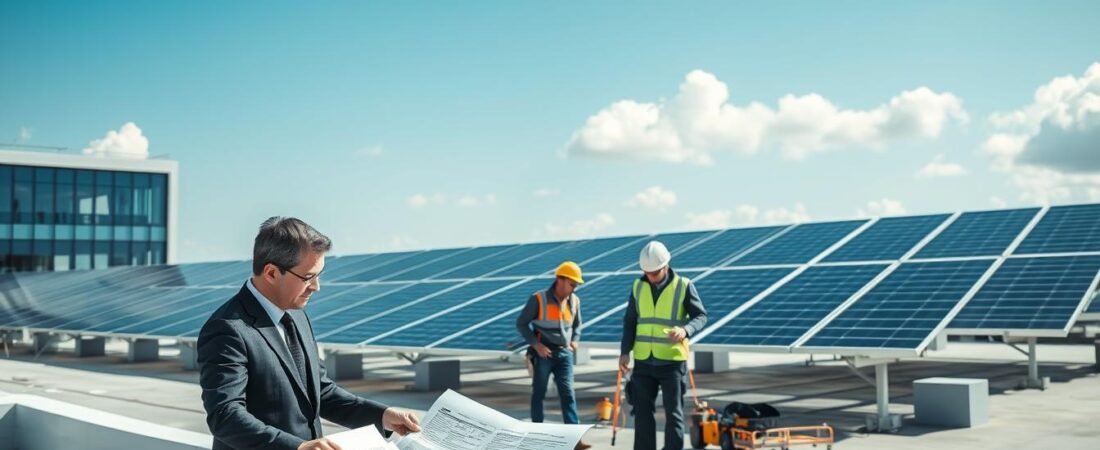
Commercial solar installations grew by 17% from 2023 to 2024, and that trend matters if you want to cut fixed costs and claim tax advantages. This guide shows how a smart business solar panel installation can turn a facility into a modern, energy-efficient building with lower electricity bills.
We walk through the core steps of a commercial solar project so you can follow the process with confidence. Learn how to evaluate system size, compare costs, and find incentives and tax credit options that boost savings. Every project needs planning, permits, and a qualified company to handle utility rules and equipment choices.
This short guide keeps things clear. From initial consultation to final activation, we highlight the benefits, risks, and key factors that affect return on investment. Use these insights to plan successful commercial solar systems that match your goals for clean energy and long-term savings.
Understanding the Benefits of Commercial Solar
Switching to commercial rooftop generation can lock in predictable energy expenses and strengthen cash flow. A growing number of companies—reflected in the 17% rise in commercial solar installations from 2023 to 2024—see long-term value in this approach.
Financial Stability
Predictable costs: A commercial solar installation lets organizations hedge against rising utility rates and reduce exposure to volatile electricity markets.
Incentives and tax advantages: Federal credits and local incentives help lower upfront cost and improve the return on investment. Over time, these savings improve operational budgets and support capital planning.
Environmental Impact
Installing panels lowers a facility’s carbon footprint and cuts greenhouse gas emissions. That visible commitment often resonates with customers and staff, boosting reputation and satisfaction.
Energy independence: By reducing grid reliance, a well-designed system increases resilience and steady power availability for critical operations.
- Long-term savings and predictable utility costs
- Improved brand reputation through sustainability
- Tax credits and incentives that improve payback
How a Business Solar Panel Installation Works
Capture, convert, connect: a commercial solar system collects sunlight, changes it into usable electricity, and ties that power into your facility. Photovoltaic cells on the roof produce direct current (DC) as they absorb light.
An inverter then converts DC into alternating current (AC), the form that runs lights, machines, and HVAC. This conversion is the core of the solar installation process and determines daily output.
Well-chosen equipment and proper positioning let the system capture more energy across the day. Excess generation can flow back to the utility grid, often earning credits through net metering.
Durability and monitoring matter. Modern solar panels are built to last, and monitoring tools help you spot dips in production fast. That makes it easier to optimize performance and lower electricity bills over time.
- Photovoltaic cells → DC generation
- Inverter → DC to AC conversion
- Grid interaction → export or credit for excess power
Understanding these steps helps owners track output, plan maintenance, and get the most from their commercial solar investment.
Evaluating Costs and Financial Incentives
Start with a cost analysis to reveal how credits and depreciation change your payback timeline.
Federal Investment Tax Credit
The federal investment tax credit currently reduces qualifying commercial solar projects by 30%. This tax credit cuts the upfront cost and directly improves ROI.
Depreciation Benefits
Companies can claim accelerated depreciation. That allows about 60% of the cost basis to be depreciated in year one.
This boost shortens the effective payback. Average ROI in 2024 was 16.2% with a payback near 9.5 years.
Additional Grants and Credits
Check state grants and utility credits to lower costs further. A typical commercial cost is about $1.46 per watt, so incentives add meaningful savings.
| Incentive | Effect | Typical Value |
|---|---|---|
| Federal investment tax credit | Reduces upfront cost | 30% |
| Accelerated depreciation | Year-one tax deduction | 60% cost basis |
| State / utility credits | Additional cost offsets | Varies by state |
Selecting the Right Solar Equipment for Your Facility
Picking the right equipment shapes how efficiently your commercial solar system produces power over decades.
Commercial solar panels are larger than residential modules, commonly about 45″ x 90″. That size helps maximize energy output on large roofs and improves overall system yield.
Comparing Inverter Technologies
String inverters are cost-effective and work well on uniform roofs. They centralize conversion and are simple to service.
Microinverters attach to each module and boost performance where shading or mismatch exists. They add monitoring at the module level.
Power optimizers combine benefits of both. They improve module-level output while keeping inverter costs lower than full microinverter arrays.
| Technology | Best for | Cost | Module-level monitoring |
|---|---|---|---|
| String inverter | Large, uniform roofs | Lower | No |
| Microinverter | Shaded or complex roofs | Higher | Yes |
| Power optimizer + string | Mixed orientation roofs | Moderate | Yes |
Durability, warranty, and brand reputation—brands like Axitec, SEG, and Qcells—should guide final choices. Your installer will weigh costs, incentives, and expected electricity savings to recommend the best combination for your facility.
Finding a Reliable Solar Installer
Choose a vetted installer to protect your investment and ensure projects finish on time. A reputable commercial solar installer should hold certifications like NABCEP or training from Solar Energy International.
Ask for references and recent project examples from the company. Confirm they have experience with commercial solar installation and with systems similar to your building.
Check online reviews on Google and SolarReviews.com to see feedback from other U.S. clients. Look for patterns in service quality, timeliness, and post‑commission support.
The best partners act as consultants. They explain tax credits, incentives, expected electricity savings, and ongoing costs. They also present a clear project scope and warranty packages that extend beyond manufacturer guarantees.
- Verify certifications and trade history
- Review references and online ratings
- Require a detailed scope, timeline, and warranty
Working with an experienced company gives you confidence that the system will deliver performance, maintenance, and long‑term savings.
Reviewing Your Solar Proposal
A careful review of each proposal helps you spot real value and hidden costs before committing to a commercial solar project.
Check the financials. The proposal should include a full ROI forecast, a payback period, and annual electricity savings. These numbers let you compare offers on an apples-to-apples basis.
Confirm the scope. Equipment brands, system size, expected energy offset, and any exclusions must be spelled out. Look for clarity on permitting, utility interconnection, and potential change orders.
Inspect warranties and guarantees. Manufacturer and company warranties protect your investment. Note warranty lengths, coverage limits, and service commitments.
Know the terms. Payment schedule, tax credit handling, incentives, and the installation timeline should be explicit. Ask the solar installer to explain anything that is unclear.
| Proposal Element | What to expect | Why it matters |
|---|---|---|
| Financial analysis | ROI, payback, savings | Shows true investment value |
| Project scope | System size, brands, inclusions | Prevents scope creep and surprises |
| Warranties | Manufacturer and company terms | Protects long-term performance |
| Payment & timeline | Milestones and tax credit handling | Keeps project on schedule and budget |
The Step-by-Step Installation Process
A six-step workflow guides most commercial projects from site survey to grid hookup.
1. Custom evaluation: A consultant inspects the roof, electrical service, and load profile. They size the system and note shading, roof condition, and incentives.
2. Quote and contract: You receive a detailed proposal. Once signed, the team schedules permits and orders equipment.
- Permitting: The installer secures local approvals and utility interconnection.
- Construction: Crews mount arrays and tie into the building with minimal disruption.
- Inspection & commissioning: Final tests confirm safe operation before grid connection.
Timelines vary: small systems can finish in weeks. Larger commercial solar projects may take months.
“Clear milestones and open updates keep stakeholders confident and the project on track.”
Final note: A professional team will keep you informed throughout the process. For a deeper look at each step, see the solar installation process.
Long-Term Maintenance and System Performance
A proactive maintenance plan protects your energy yield and long-term returns. Regular checks keep a commercial solar system reliable and reduce surprises with electricity output.
Managing Inverter and Component Warranties
Know warranty lengths. Leading brands back solar panels for 25 to 30 years. Inverters often carry 10 to 25-year warranties because they are the system’s most complex part.
Track coverage carefully. Save invoices and serial numbers. Register equipment with manufacturers and keep your installer informed if service is needed.
Choose a partner that offers workmanship protection. For example, Paradise Energy’s Triple Ten Guarantee gives a ten-year workmanship warranty plus a production promise. That extra coverage lowers risk and can simplify tax and service questions.
- Monitor performance to spot drops early and avoid downtime.
- Schedule professional inverter checks as recommended by your solar installer.
- Keep warranty documents handy to speed repairs and claims.
“Regular maintenance and clear warranty management keep the system productive for decades.”
Conclusion: Taking the Next Step Toward Energy Independence
Moving from planning to action means targeting incentives, picking the right system, and setting clear performance goals. Use the federal investment tax credit and local incentives to cut upfront costs and speed payback.
Request a custom solar panel installation quote that shows expected electricity savings and timelines. A clear solar installation process reduces surprises and keeps teams aligned.
Choose a trusted installer with commercial experience to design a commercial solar system that fits your building and goals. This step protects performance and warranty claims.
Start now to capture long-term savings, improve reputation with clean energy, and reduce your carbon footprint. Reach out for a quote and make your project count.