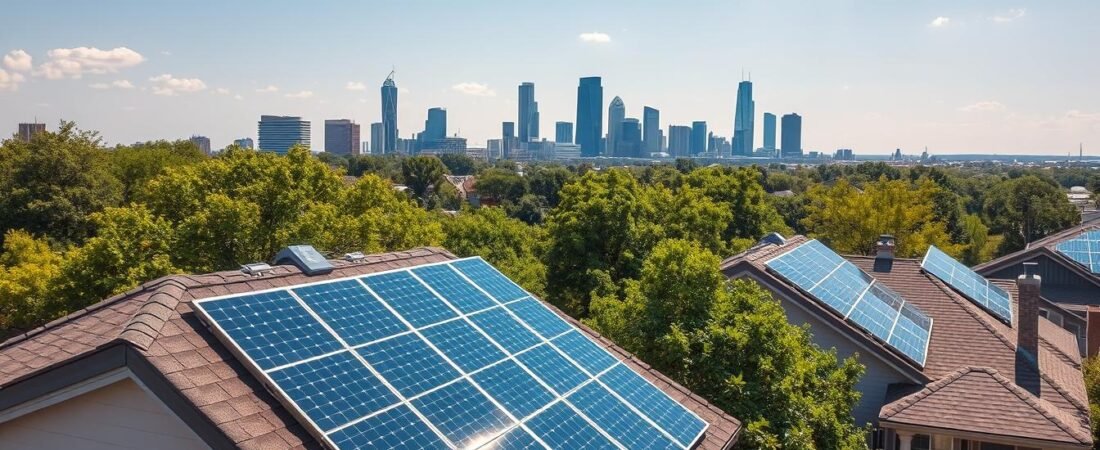
Thinking about switching to rooftop energy? As of April 2026, the average system runs about $2.17 per watt installed. That number gives a quick estimate, but the final price depends on your roof, system size, equipment and incentives.
Many homeowners see strong returns over a 25–30 year lifetime. Rising electricity rates make predictable energy bills an attractive benefit.
Getting quotes is free, and skipping them can cost you thousands over time. Compare several installations to match price, warranty and local net metering rules.
Our guide shares up-to-date data on prices, tax credit availability, and utility rules. Read on to learn how to estimate savings and find the right company for your home.
Understanding the Solar Landscape in Austin
Austin’s bright skies make rooftop power production an especially attractive option for local homeowners.
The city averages about 5.4 peak sun hours per day, which helps a typical system produce steady energy year-round. That sunlight, combined with a 28% rise in electricity prices from 2020 to 2024, is driving more residents to consider alternatives.
Generating your own electricity reduces how much you depend on the grid. It also helps shield household budgets from rising utility bills.
“Producing power at home can lock in more predictable monthly expenses and increase energy independence.”
- Abundant sun makes panels effective for many homes.
- Higher utility rates motivate homeowners to explore systems that lower long-term costs.
- Local adoption is growing as residents seek stable energy and predictable bills.
Understanding the local market is the first step to deciding whether going solar fits your home and finances.
Current Solar Panel Cost Austin TX Estimates
Knowing the going rate per watt makes comparing offers simple and fast. Below we summarize market averages and a clear per-watt breakdown so you can get a fast estimate for your home.
Average Market Pricing
As of April 2026, the average solar panel system runs about $2.17 per watt installed. That figure is a quick benchmark to compare quotes across installers.
A full-size example: a 13.67 kW system typically ranges from $25,180 to $34,066 before incentives. Smaller systems cost less; a 5 kW setup is about $10,838.
Price Per Watt Breakdown
We use $/W so you can compare offers that vary slightly in size or equipment. Doubling system size roughly doubles the price, so a 10 kW system will cost about twice a 5 kW example.
| System Size | Price Range | Approx. $/W |
|---|---|---|
| 5 kW | $10,838 | $2.17 |
| 13.67 kW (avg) | $25,180 – $34,066 | $1.84 – $2.49 |
| 10 kW (estimate) | ~$21,700 | $2.17 |
Tip: Review quotes by price per watt and equipment specs. That helps homeowners spot the best value and avoid overpaying based on brand names alone.
How System Size Impacts Your Total Investment
How big your setup is will determine the total price and the share of household electricity it can replace.
The average system size in Austin, TX is 13.67 kW, designed to offset a significant portion of a typical home’s usage. Larger systems cost more up front, but they produce more energy and reduce monthly bills faster.
A 10 kW system in this market typically runs about $21,676. We use per watt pricing to compare offers so you can see value across different sizes and equipment choices.
Homeowners should match system capacity to real consumption. Oversizing leads to higher installation expenses and unused generation. Undersizing leaves you buying more grid electricity.
- Average size: 13.67 kW — offsets much of a home’s electricity.
- 10 kW example: ≈ $21,676 — reflects installation scale.
- Compare by $/watt to understand true investment.
Bottom line: pick a system size that balances upfront price with long‑term savings to maximize your investment and meet your home’s energy needs.
Financial Benefits of Going Solar
A home energy system often pays for itself in about a decade when local rates and incentives are counted.
Projected Savings Over Time
Homeowners in Austin, TX can expect strong long‑term returns. On average, families save about $64,098 over 25 years on their electricity bills after installing solar panels.
The typical payback period is roughly 10.18 years. After that point, your production effectively lowers monthly bills and boosts home value.
- Average 25‑year savings: $64,098.
- Payback: ~10.18 years, then mostly free energy.
- Federal tax credit can reduce upfront expense and improve returns.
- Net metering and utility incentives help maximize lifetime savings.
“Going green often translates into greater predictability and protection from rising rates.”
Final savings depend on your usage, roof orientation, system size and panel efficiency. Get tailored quotes to project your specific returns and timeline.
Navigating Texas Solar Property Tax Exemptions
Installing a home energy system won’t automatically raise your annual property taxes thanks to state law. Under Texas Tax Code Section 11.27, the added value from a qualifying installation is excluded from property tax assessments.
What this means for homeowners:
- The added home value from your solar panels is 100% exempt under Section 11.27.
- That exemption can save an estimated $400–$600 per year, adding up to over $10,000 across a system’s lifetime.
- To qualify, systems must be owned (not leased) and used primarily for on‑site energy production.
- File Form 50‑123 with your county appraisal district by April 30 of the tax year to claim the benefit.
“This permanent exemption helps protect your investment by preventing higher annual taxes when your home value rises.”
Bottom line: include the tax exemption when you model installation payback and long‑term costs. Filing on time locks in savings and improves your ROI.
Available Local Rebates and Utility Incentives
Stacking local rebates with federal credits often changes the math for homeowners considering an on‑site system. Understanding programs from your city and utility helps lower upfront charges and speed up payback.
Austin Energy Programs
Austin Energy uses a Buy‑All, Sell‑All Value of Solar program that credits production and offsets monthly electricity bills.
Check the utility’s current offer to see how production credits apply to your rate. For details visit the Value of Solar program.
Sunset Valley Rebates
The City of Sunset Valley provides a supplemental rebate of $1.00 per watt installed, up to $3,000 for qualifying systems.
This local rebate stacks with federal incentives and can meaningfully reduce your initial outlay.
Federal Tax Credit Benefits
The federal tax credit lets homeowners claim 30% of eligible system expenses on federal taxes for installations through 2031.
Combined with local rebates and utility credits, the tax credit makes clean power more affordable and shortens the payback period.
“Use local rebates and the federal tax credit together to maximize savings and lower the effective price of your system.”
Comparing Cash Purchases Versus Solar Loans
Choosing between paying up front or financing affects payback, monthly budgets, and total interest paid.
Cash purchases deliver the shortest payback period and the lowest lifetime expense because you avoid interest. If you can fund the system, you capture the full federal tax credit and maximize long‑term savings.
Loans let many homeowners start with little or no money down. You still own the equipment and can claim the tax credit, but monthly payments add interest that raises the total price over the loan term.
Which fits your situation? If you prefer a fast return and lower lifetime outlay, cash is best. If you need to preserve savings and spread payments, a loan can make an installation possible today.
| Feature | Cash | Loan |
|---|---|---|
| Upfront payment | Yes | No (often $0 down) |
| Ownership | Full | Full |
| Federal tax credit | Claimable | Claimable |
| Lifetime total | Lowest (no interest) | Higher (interest added) |
Tip: Compare the total price including interest, projected energy savings, and incentives. For a side‑by‑side look at financing options, see our cash vs loan vs lease options.
“Owning your equipment usually boosts long‑term savings and helps increase home value.”
Evaluating Solar Leases and Power Purchase Agreements
Leasing and PPA contracts let homeowners access clean electricity without buying equipment outright. These options move ownership to the installer and simplify maintenance and monitoring.
Pros and cons matter. A lease often requires no money up front and yields immediate monthly savings. The installer handles repairs and performance tracking.
Pros and Cons of Leasing
- Pros: No large upfront price, lower monthly bills at the start, and maintenance included.
- Cons: You do not claim the federal tax credit and home value may rise less than with ownership.
- Programs like Palmetto’s LightReach offer fixed monthly payments as an example of lease simplicity.
| Feature | Lease / PPA | Purchase |
|---|---|---|
| Ownership | Installer | Homeowner |
| Upfront payment | No (often) | Yes |
| Federal tax credit | No | Yes |
| Maintenance | Included | Owner responsibility / warranty |
“Leases provide convenience, but buying usually wins on long-term savings.”
Essential Factors That Influence Your Final Quote
A handful of key choices determine the final quote more than any single number.
Your equipment quality, installer experience, and roof type shape the realistic price for a home system.
High-efficiency modules and strong warranties raise upfront price but improve long‑term savings. An experienced installer reduces surprises and speeds installation time.
Batteries add substantial value and expense. Expect batteries to increase a quote by $10,000 or more, yet they offer crucial power security during outages.
- Your energy use and desired system size directly affect the total investment.
- Getting at least three quotes encourages competitive pricing and clearer equipment comparisons.
- Local installers often know utility rules and rebates better than national firms, which can save you money.
Don’t forget incentives: the federal tax credit and local rebates will lower the final price when applied to your estimate.
“Compare equipment specs, warranties, and total out‑the‑door price before deciding.”
Long Term Maintenance and Operational Costs
Small annual expenses help protect the long-term performance of your home energy system. Routine attention keeps panels producing at peak and helps you avoid surprise repair bills.
Cleaning and Debris Removal
Keep a simple schedule: check your array twice a year and after big storms. Clear leaves, bird droppings, and dust so sunlight reaches every panel.
Typical cleaning runs about $200 for most residential sizes. That price varies with roof access and system size, but the service preserves energy output and extends life.
- Inspect after severe weather.
- Trim trees that cast shade on panels.
- Budget for periodic cleaning to maintain watt output.
Repair and Warranty Considerations
Minor repairs usually range from $100 to $500 depending on brand and damage. Check your warranty before paying out of pocket.
Good warranties cut long-term costs and cover many failures that would otherwise hit your pocketbook. Keep installation and manufacturer paperwork handy.
“Planned upkeep and a solid warranty make the difference between small fees and large replacements.”
Selecting the Right Installer for Your Home
Choosing a reputable installer matters more than chasing the lowest price. A vetted contractor ensures safe work, correct permits, and a smooth interconnection with your utility.
Texas has more than 250 companies to choose from, so compare offers carefully. Ask each company about warranties, crew experience, and permit handling.
We recommend talking to at least two or three firms. That helps you compare equipment, total installation charges, and service guarantees.
- Check online reviews and ask for local references.
- Confirm the installer will manage permits and utility paperwork.
- Prefer companies that offer clear warranties and workmanship guarantees.
| What to Ask | Why It Matters | Red Flags |
|---|---|---|
| License & insurance | Protects you from liability and code violations | Refuses proof or vague answers |
| References & reviews | Shows real performance and service quality | No local references or many complaints |
| Permit & interconnection handling | Saves time and avoids delays with the utility | Suggests you do the paperwork |
“Invest time vetting installers — it pays off in reliable production and fewer surprises.”
Spend a little more effort up front. The right installer will protect your investment, speed approval, and help your home energy system perform for years.
Conclusion
, Smart planning around incentives and system size helps homeowners maximize long‑term returns.
Going solar here means predictable electricity bills, real savings, and more energy independence. Use the federal tax credit, local rebates, and the property tax exemption to lower your upfront price.
Compare multiple vetted installers, check per watt estimates, and confirm net metering rules before you sign. That approach protects your investment and improves lifetime savings.
Ready to take the next step? Learn more about our team and process at about our team and get tailored quotes to find the best fit for your roof and budget.